LRBA and bare trust rules for SMSF loans
A plain English guide to the borrowing rules, the August 2026 changes, and getting your property paperwork right before you sign.
By Natalie Hawkes, Mortgage Broker 7 November 2026 8 minute read
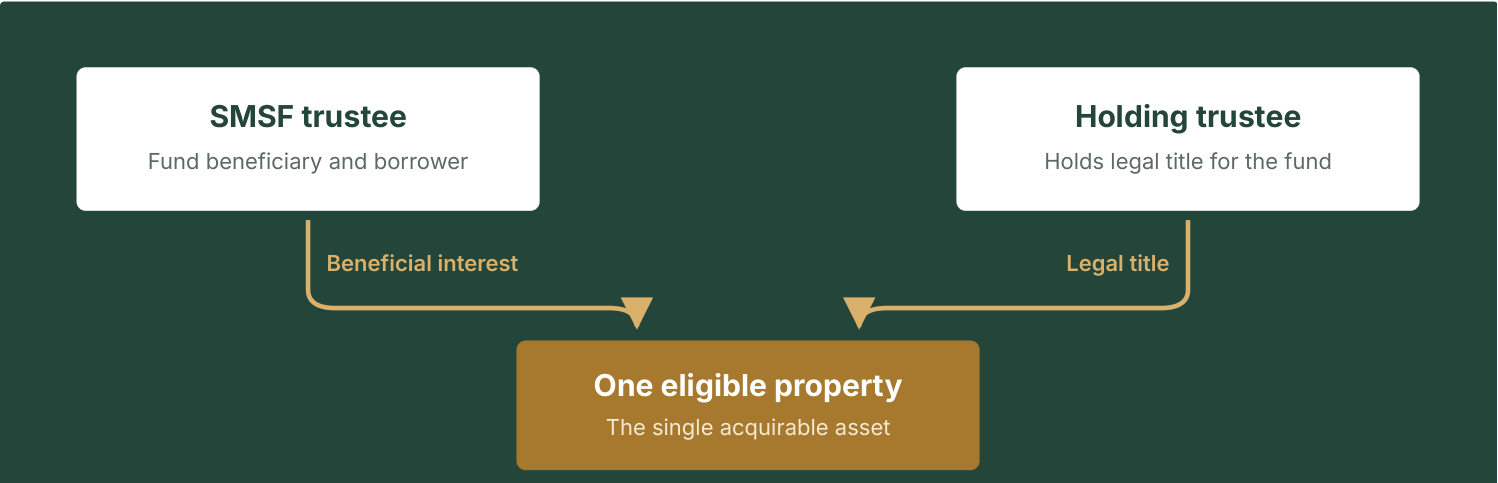
Simplified standard LRBA ownership picture. The holding trust is the legal arrangement through which the holding trustee holds the property for the SMSF. Your solicitor must confirm the actual structure.
SMSF lending comes with a few unfamiliar names. Two you will hear early are LRBA and bare trust. They are connected, but they do different jobs: the LRBA is the borrowing arrangement; the bare trust, often called a holding trust, is part of the ownership structure.
You do not need to become an expert in trust law to start a conversation. You do need your advisers checking the structure and documents before you commit.
What is an LRBA
LRBA stands for limited recourse borrowing arrangement. It is an exception to the general restriction on SMSFs borrowing. It allows an eligible asset to be acquired using borrowed money, provided the arrangement meets strict conditions.1
In a standard property LRBA, the SMSF trustee borrows and a separate holding trustee holds the property for the fund. The fund has the beneficial interest: the investment is held for its benefit. The holding trustee holds legal title.1
What does limited recourse mean
The rules restrict rights against the SMSF trustee to the asset acquired under the arrangement.
Limited recourse does not make the investment risk free. The property can be lost if the loan is not paid.
A personal guarantee can create separate exposure for the guarantor. Have your solicitor explain all guarantees and obligations.1,4
The rules to understand before buying
One arrangement generally means one acquirable asset
A package of properties, separate titles or a building with a separately titled car bay won't necessarily fit within one LRBA. Some combinations can qualify as one asset, but the legal facts matter. Give your solicitor and lender all title details before proceeding.2
The holding trust has a specific purpose
It holds the asset so the SMSF trustee has a beneficial interest and a right to acquire legal ownership after the required payments. The law does not prescribe the label bare trust. The documents must create the required rights; the trust name alone does not establish compliance.1
The two trustee roles are different
The SMSF trustee runs the fund. The holding trustee holds legal title under the holding trust. A corporate trustee is a company acting as trustee. Your solicitor and lender must confirm which entities are needed and who acts in each role. Do not assume your trading company is suitable.1
Repairs and improvements are treated differently
Borrowed money under an LRBA cannot be used to improve the asset. Eligible repairs or maintenance may be permitted, subject to the rules and loan terms. Work funded with the fund's own money also needs checking: an alteration must not turn the property into a different asset while the LRBA remains in place.2
Give your advisers the scope and cost of any fit-out, extension or redevelopment before committing. The purchase loan can't be used for improvements, so plan how any works will be funded.
Checking the structure before signing
Fictional example only. This illustrates the checks, not a legal opinion, finance approval or recommendation to establish an SMSF.
Anna and Ben have an SMSF and find a commercial unit they would like the fund to buy. The agent asks for the buyer details. They are tempted to sign in their own names and change the purchaser later.
Instead, they send the proposed contract, title details and planned use to their solicitor, accountant and broker before making a commitment.
The checks identify a separately titled parking space and a proposed office fit-out. Their solicitor reviews whether the titles can satisfy the single-asset rules. Their accountant checks the business real property position, the investment strategy and cash needs. Their broker checks what the lender will accept.
The fit-out is assessed separately. Anna and Ben do not assume it can be paid for with the purchase borrowing. The solicitor confirms the correct purchaser and the timing of the company, trust and contract documents.
They proceed only once the advisers have resolved the structure and funding questions. The benefit is a properly checked purchase, rather than a promise that incorrect documents can be fixed later.
Get the order right before signing

Begin with the fund. An appropriately authorised financial adviser can assess whether the strategy suits the members. Your accountant can review tax, the trust deed and administration matters within their scope. The investment strategy and cash flow need to support the purchase.4
Always seek advice from your accountant or financial adviser about tax and costs.
Confirm the legal structure. Have your solicitor establish the correct ownership roles, documents and purchaser details. Get advice from a solicitor in the state where the property is located on the contract and deed execution order and any duty implications before signing.
Coordinate the finance. Your broker can work through lender requirements alongside the legal process. Lender policy and superannuation law are separate checks. Loan approval does not prove the trust or contract is correct.
What lenders look for
On top of the law, each lender applies its own policy, and SMSF policies differ more than most. Matching your fund and property to the right lender is where a broker can help.
DEPOSIT 20–30%
Most lenders require a deposit of 20 to 30% of the purchase price, depending on the lender. Purchase costs such as duty and legal fees come on top.
CASH AFTER SETTLEMENT Varies by lender
Some lenders require the fund to hold cash after settlement; others don't. It is worth knowing before you choose a lender.
AFFORDABILITY Rent + contributions
Lenders look at the rent the property will earn and the members' super contributions to work out whether the fund can afford the repayments.
TRUSTEE STRUCTURE Corporate trustee
The lenders we work with generally require the SMSF to have a corporate trustee, so factor this into your setup plans and costs.
Frequently asked questions
Q Are an LRBA and a bare trust the same thing?
No. The LRBA is the borrowing arrangement. The holding trust is part of the structure that holds the asset for the fund. The holding trustee holds legal title; the SMSF trustee has the beneficial interest.1
Q Do both trustees have to be companies?
Not necessarily as a matter of law, but in practice lenders generally require a corporate trustee for the SMSF and may have their own requirements for the holding trust. Have your solicitor confirm the legal position and your broker confirm the chosen lender's requirements.
Q Can we use a family discretionary trust instead?
Generally, no. A discretionary trust does not give the SMSF trustee the required beneficial interest in a particular asset. Have the correct holding trust documents prepared for the transaction.1
Q Can the loan be refinanced later?
Potentially. Refinancing must meet the applicable rules and the new lender's requirements. Earlier borrowings have transitional protection under the 2026 change, but this is not blanket permission to change assets or restructure ownership. Have the existing and proposed documents reviewed.1,3
Q Does paying off the loan automatically change the title?
No. The SMSF trustee has the right to acquire legal ownership after the required payments. Your solicitor should advise how and when to deal with the title, holding trust and any duty consequences.1
General information only. This article does not consider your objectives, financial situation or needs and is not personal financial, tax or legal advice. SMSF borrowing involves risk and strict rules. Obtain advice from appropriately qualified professionals before entering an arrangement, signing a contract or changing ownership. Lender policies and laws can change. Natalie Hawkes is Credit Representative 479789 of Australian Finance Group Ltd, Australian Credit Licence 389087.
SOURCES · CHECKED 7 NOVEMBER 2026
1. ATO: SMSFs and limited recourse borrowing arrangements
2. ATO: SMSFR 2012/1, single assets, repairs and improvements
3. Treasury Laws Amendment (Tax Reform No. 1) Act 2026, Sch 5
4. ASIC Moneysmart: SMSFs and property
5. ATO: SMSFR 2009/1, business real property
6. ATO: Changes to LRBAs for property from 10 August